
Confessions of a Converted Software Investor
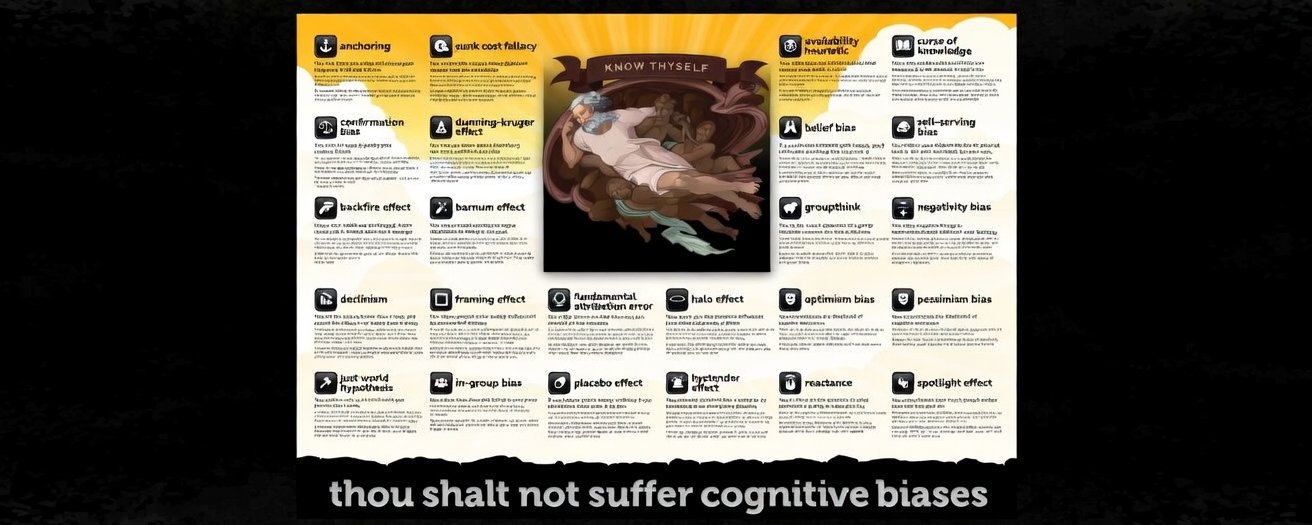
When my sons were in middle school, I decided to introduce them to the idea of cognitive biases – so I hung this poster in each of their rooms.
I should have pasted a third copy to my own bathroom mirror.
From the ChatGPT moment, and especially shortly thereafter when I understood that transformer technology was, at its core, a composition of age-old mathematics, I knew this technology was special. It was genius in its architecture and brilliant in the underlying simplicity of its foundations. The scaling laws were promising and then unbroken, as still today.
Despite the obvious capacity of AI to represent context so richly, I persisted in suffering the classic sunk cost fallacy and other biases. I made excuses. I masked them as prudent investor skepticism. They were just excuses.
Just a few weeks ago, when I dove headlong into experimenting with OpenClaw, I finally saw the light. The capacity of this technology, now coupled with what I could see as the very beginnings of its potential to be orchestrated, finally pounded reality into me.
Most of the time since, I’ve thought about this in the context of my background, enterprise software applications investing. As much as I believe that my awakening applies to infrastructure, security and other forms of enterprise software, not to mention commerce more broadly, my strongest convictions are about the domain I know best. Those are stark enough, and the hard reality is that enterprise software, as we’ve come to know it over the last two plus decades, is no longer.
Worse, nearly every incumbent, most of them constrained by either the narrowness of their domains or silos otherwise, have few discernable advantages that I can see from their incumbency that will apply differentially to driving future software value for enterprises. For these companies, this moment is an Innovator’s Dilemma problem of epic proportions.
The amount of ink that has been spilled prognosticating the future of enterprise software is almost as large as the chasm between those predictions and what I think will really matter. Many of those prognostications are directionally accurate, they are just wholly incomplete and miss the larger point, and not just about the timing.
Sure, narrowly, it is true that simple applications, learned interfaces, those reliant on public data, and even customized business logic will almost certainly be first in line to be obviated. With the cost of software production arcing towards zero, these applications will be replaced with better, cheaper and agent first solutions. Fairly quickly in my view, although change management at the human decision-making level always seems to take longer than it should. This said, the comparative value proposition, old versus new, will be stark enough that it seems all but certain to happen quickly.
Some (including me for too long) continue to cling to the notion that enterprise software requires determinism, and that probabilistic solutions are not made to order. This is true, but it misses the more important reality that modern probabilistic coding solutions spin up deterministic code essentially at the push of a button. Specifications still matter, more for more complex solutions, but models spin those up too and can run seemingly endless simulations that test and quality check both front end specifications and the back-end code once built. What to code remains the only real question, and impressively AI is highly capable with discovery and scenario planning on those fronts as well.
Relatedly, and notwithstanding that most enterprises aren’t dying to change their ERP or other core systems, it’s also true that complex solutions, such as sophisticated System of Record or solutions with high compliance requirements, will likely be overhauled on a somewhat longer timeline. Maybe three years, but not likely ten. Aside from the status quo bias, it is noteworthy that most of the barriers for enterprises to changing these solutions are the result of the frictions associated with change management, including heretofore complicated implementations. The technology barriers to significantly minimizing or eliminating these non-human change management frictions (not least the ones that bedevil implementations) are in many cases already solved, and the limitations that do remain are quickly dwindling.
Many have identified other so-called ‘sustaining moats’. Things like proprietary data, network effects or transaction embeddings. On closer inspection, each of these seem to reveal their own vulnerabilities, and an initial observation about the larger conundrum facing traditional enterprise software.
Proprietary data has become all but a buzzword in the current software vernacular. Yet few that I’ve seen in the enterprise software provider space seem to spend much time outlining why and how this self-proclaimed ‘proprietary’ data, as opposed to the data already owned by the enterprise customer, is or can be made differentially valuable to that customer. Is it truly different than similar data that could otherwise be obtained or triangulated from other sources (agents)? More importantly, what can be done with this data at the product level to add value? Perhaps some great products will in fact emerge, but so far, it feels like specific solutions that truly leverage this ‘proprietary’ data (again as distinct to the enterprise’s own data) into a differential and unique value proposition for the customer, seems to remain lacking.
The next idea is ‘network effects’. Keep in mind that most who discuss this topic do so in the context of traditional human to human interactions where the scarce resource is human attention. The agent world does not have this constraint. There are many two-sided networks currently functioning in commerce that, at their core, aggregate liquidity in service to addressing the scarce human attention problem. Agent enabled participants don’t need to concentrate their ‘valuable’ time only where deep volumes of liquidity are aggregated. The agent just works endlessly, checking all sources of supply or demand, whether or not they are in large or small pools. This change in dynamic applies broadly, to one and two-sided networks alike.
Another is transactions embeddings. The key insight for me in this category is the core assumption of pre-existing and traditional payment rails. As much as this isn’t my area of expertise, agent to agent commerce seems destined to become reality and I can envision decentralized payments challenging traditional networks in this context.
The broader point is that these discussions are mostly backwards looking and defensive, as the term ‘moats’ definitionally implies. Ironic, in some sense for an industry that created itself through innovation.
The real question is what’s next? One of the most significant market signals from enterprises currently is the demand to make AI work, to diffuse it across the entirety of their business processes. What is an enterprise after all, other than its unique talent, data, physical and capital resources and business processes? Palantir is a notable example here. But also, the efforts by the Anthropic, Open AI, Mistral and other labs who are racing to build FDE models to serve this demand.
Setting aside that software incumbents, like most others in the world, are still racing to learn and keep up with AI themselves, very few start from a position that isn’t constrained by the silo or domain of the business context they currently touch through their existing incumbency. This seems like a decided disadvantage for an era where orchestration of business processes, ones that span across software silos, is becoming increasingly possible. Some software vendors, those with larger footprints within their enterprise customers (ERP provider SAP being a good example) have stronger beginning footholds than others. Still, even these incumbents are constrained by the extent of their existing enterprise context footprint, which is nearly universally just a subset of the end-to-end business processes of their customers. Many of these incumbents are (oddly in some respects) embracing open source agentic APIs such as MCP. Regardless, these companies will need to expand to a more complete footprint of the context of their enterprise customers quickly to have a shot at capturing the broader orchestration potential that AI promises. Orchestration is where the demand is today and seems likely to be where a lot, if not most of the future profit pools from enterprise customers will reside, at least for so long as the AI diffusion era lasts. Very few other software incumbents are well positioned in this dimension.
One exception, directionally at least, are companies like Celonis, which from their beginning, focused on process workflows that have sought to span across enterprise context silos in service to business process intelligence, debugging and streamlining. I can readily envision a world where a company like Celonis, once thought to occupy only a smallish enterprise niche, is now well-positioned to be a significant player in the master orchestrator race, challenging Palantir and the FDEs being deployed by the large labs with a more productized (not to mention probably more cost effective) solution to enterprise orchestration.
For the better part of the last two plus years, traditional enterprise software incumbents have been racing to ‘agentify’ their offerings. There is surely incremental value to be created from doing so effectively. The larger issue, as alluded to above, is that enterprise customers will ultimately seek to orchestrate their systems and agents end-to-end, independent and across the embedded silos that have brought enterprise software where it is today. For this reason, I suspect that the half-life of value creation for the so-called ‘agentifying’ within silos will be short, and the ultimate race will be for master orchestrator position, in the stack.
Should this materialize as many envision, most incumbent enterprise software solutions are at high risk for being reduced to low value-added tools. As Nvidia’s Jensen Huang asked recently when discussing enterprise software in relation to AI, ‘Would you use a screwdriver or invent a new screwdriver?’ The implications of this for traditional enterprise software, being reduced to being a ‘screwdriver’, are profound. Not that enterprise software is ‘going away’ (quite the opposite actually), but rather the ability (or lack thereof) of incumbents to create new and relevant value for their customers, and by extension capture an attractive portion of it for their shareholders.
This is a new race altogether and one that feels very existential to most incumbent enterprise software providers. The cost for building software is arcing towards zero. Domain expertise, setting aside that it may now be easily replicated with AI itself, is mostly too narrow to be competitively advantaged in the end-to-end orchestration race. The technical barriers to unleashing this brave new world, not least reducing the frictions of systems replacement, are becoming fewer by the day. Competition will almost certainly be unprecedented, as will the pace of innovation.
For investors this revolution reduces visibility, increases risks and manifests ultimately in terminal values. In many instances, I can see that incumbency and the traditional ‘moats’, will not only be more at risk, and I think much more quickly than many believe, but that the limited surface area of those siloed solutions inside of the enterprise could end up being a decided disadvantage. A more acute version of the Innovator’s Dilemma.
As for the value of the terminus itself, even at current post-SaaSpolcalypse levels, I think it remains materially overvalued by investors. Just last week famed investor (not in technology btw) Howard Marks was asked what he thought investors were most underestimating today. His response was, ‘Well, I think most people are underestimating the impact of AI.’
It took a proverbial sledge hammer example of the orchestration potential of AI for me to finally see it. OpenClaw delivered that blow. I couldn’t agree with Howard more. There will surely be wonderful enterprise opportunities for the innovation leaders of Al technology, it’s just that I no longer view the vast majority of traditional enterprise software incumbents as being well-equipped to compete, much less be successful, in the race ahead. I’ve largely been a defender of traditional software incumbents until now, but no longer. I’m converted.